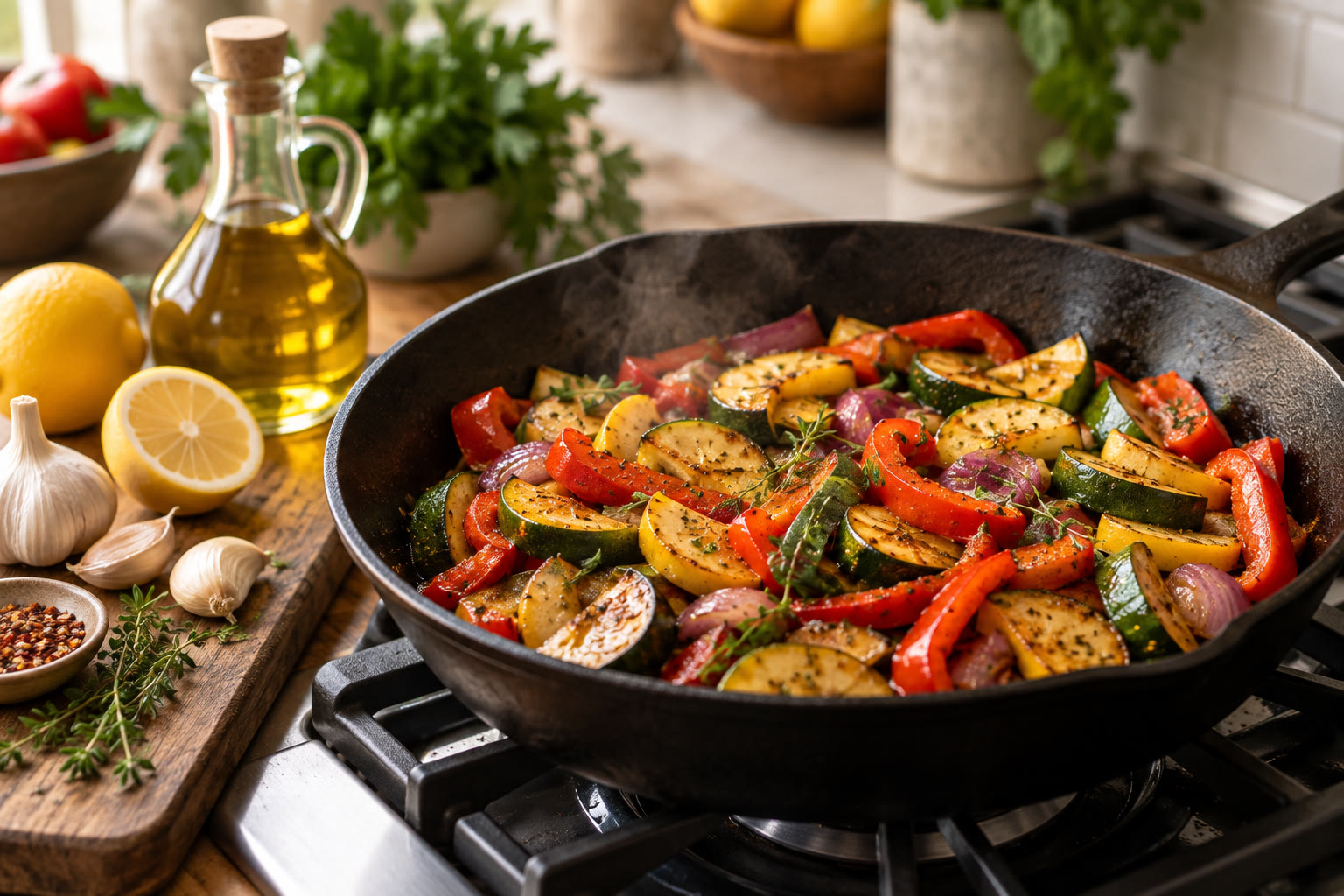
Yes, you can cook with olive oil. Extra virgin olive oil works for sautéing, baking, and most roasting. The useful limit is when the oil gives off a steady stream of smoke, not one magic number copied from a chart.
UC Davis reports olive oil smoke points from about 347°F to 464°F (175°C to 240°C). Grade matters. Quality and freshness matter too. That is why two bottles labeled olive oil can behave differently in the same pan.
Olive oil heat guidance at a glance
| Cooking job | Olive oil fit | What to watch |
|---|---|---|
| Sautéing | Good fit | Use medium or medium-high heat and lower it if the oil smokes steadily. |
| Baking | Good fit | Use it in breads, cakes, granola, and savory bakes where the flavor belongs. |
| Roasting | Good fit for most home cooking | An oven setting is not the same as the oil's temperature on the food. |
| Shallow frying | Usually a good fit | Keep the oil hot enough to cook, but below steady smoke. |
| Deep frying | Possible with temperature control | The International Olive Council places common frying temperatures below olive oil's stated smoke point. |
| Very hot searing | Use judgment | An empty pan can race past the useful range before food goes in. |
Why one smoke-point number is not enough
Smoke point changes with the oil's grade, age, quality, and condition. A fresh bottle and an old bottle that has sat open beside the stove are not the same cooking ingredient.
Refining also changes an oil. Refined olive oil is usually milder and can tolerate more heat. Extra virgin olive oil keeps more flavor and naturally occurring compounds, which is often the reason you bought it in the first place.
What steady smoke is telling you
A few wisps from a hot pan are a warning. Continuous smoke means the oil is breaking down and the pan is hotter than it needs to be. Move the pan off the burner, lower the heat, and let it settle before continuing.
The food usually benefits too. Garlic burns quickly. Herbs can turn bitter. Vegetables can scorch outside before they soften inside. The smoke alarm is not the only reason to turn the heat down.
Can you roast with extra virgin olive oil?
Yes. Roasting vegetables with extra virgin olive oil is a normal home-cooking use. A 425°F oven does not mean the thin coating of oil on moist vegetables instantly becomes 425°F. Water in the food, air movement, pan material, and cooking time all affect what happens.
Watch the food and the pan. If the oil is smoking continuously or the edges are burning before the center cooks, lower the oven temperature or shorten the cooking time.
Can you fry with olive oil?
Yes, with temperature control. The International Olive Council gives about 180°C (356°F) as an ideal frying temperature and describes olive oil's smoke point at around 210°C (410°F). UC Davis gives a wider range because olive oils differ.
Do not treat either number as a promise for every bottle. Use a thermometer for deep frying, avoid letting the oil smoke, and discard oil that smells stale, burnt, or otherwise unpleasant.
Choose the oil for the meal
Use a flavorful extra virgin olive oil when its peppery or fruity character helps the food. A milder olive oil can make sense when you want less flavor or a little more heat tolerance.
For the bottle itself, freshness and storage matter as much as a number on a chart. The olive oil buying guide explains harvest dates, packaging, origin, and bottle size. The smoke point glossary entry keeps the short definition and range in one place.
The simple kitchen rule
Cook with olive oil when its flavor fits. Use enough heat to brown the food, not enough to fill the kitchen with smoke. If the oil smokes steadily, turn the heat down.